
How to Prepare for an External Audit in Nigeria
by admin
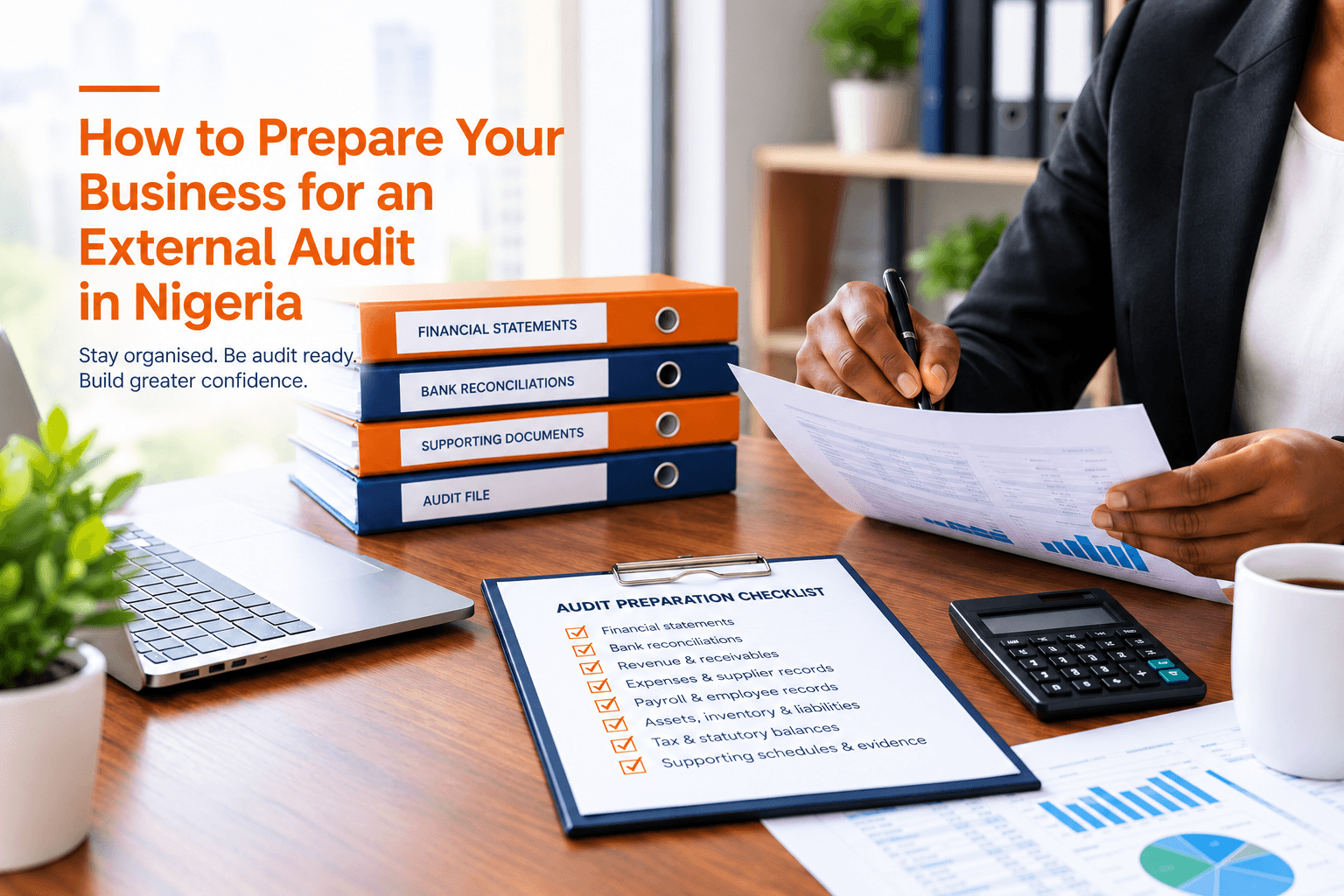
Preparing for an external audit can feel overwhelming, especially when financial records are incomplete, supporting documents are scattered across departments, or the finance team is working against a tight deadline. However, with proper planning and organised records, businesses can make the audit process more efficient and reduce unnecessary delays.
For businesses in Nigeria, external audit preparation is an important part of maintaining reliable financial records, meeting applicable statutory obligations, and building confidence among shareholders, lenders, investors, and other stakeholders.
Whether you operate a small business, a growing company, a nonprofit organisation, or an established enterprise, understanding how to prepare for an external audit can help your organisation approach the process with greater confidence.
In this guide, we explain the practical steps businesses should take before an external audit, the documents auditors commonly request, the mistakes to avoid, and how professional accounting and audit support can help.
What Is an External Audit?
An external audit is an independent examination of an organisation's financial statements and relevant supporting records by an appropriately qualified and independent auditor.
The purpose is to obtain evidence and form an opinion on whether the financial statements are prepared, in all material respects, in accordance with the applicable financial reporting framework.
Depending on the organisation and the engagement, auditors may examine revenue, expenses, assets, liabilities, bank balances, payroll records, tax-related balances, and other significant financial information.
An external audit differs from an internal audit. An internal audit generally evaluates aspects of risk management, controls, governance, and operational processes, while an external financial statement audit focuses on obtaining sufficient appropriate evidence to support an independent opinion on the financial statements.
Why Is External Audit Preparation Important?
Proper preparation helps businesses organise their records, respond to audit requests efficiently, and identify accounting issues before they become significant obstacles.
1. It Reduces Audit Delays
Auditors need access to relevant financial statements, transaction records, reconciliations, and supporting documents. When these records are missing or disorganised, the audit may take longer than expected.
Preparing the required documents in advance helps the finance team respond to requests more efficiently.
2. It Helps Identify Errors Early
Reviewing accounting records before the audit may reveal duplicate entries, unreconciled balances, incorrectly classified expenses, missing invoices, or transactions recorded in the wrong period.
Identifying these issues early gives management and the finance team time to investigate and make appropriate corrections supported by evidence.
3. It Improves Financial Reporting
Reliable financial statements help business owners and management understand the organisation's financial position and performance.
Well-maintained records also make it easier to explain significant movements in revenue, expenses, assets, and liabilities to auditors and other stakeholders.
4. It Strengthens Financial Controls
Preparing for an audit can expose weaknesses in approval procedures, document retention, payment authorisation, inventory management, and the separation of financial responsibilities.
Addressing these weaknesses can improve accountability and reduce the risk of errors or irregularities.
5. It Supports Better Business Decisions
Accurate financial information gives management a stronger basis for budgeting, investment decisions, cash flow planning, and resource allocation.
Audit preparation should therefore be viewed as more than a year-end administrative exercise. It can also help an organisation improve its financial management practices.
10 Steps to Prepare Your Business for an External Audit in Nigeria
1. Confirm the Audit Period and Applicable Requirements
Start by confirming the financial period under review, the expected audit timetable, the scope of the engagement, and the documents your auditor will require.
The applicable requirements may depend on your organisation's legal structure, size, industry, reporting framework, and statutory obligations.
For example, a company may need to consider applicable provisions of the Companies and Allied Matters Act, financial reporting requirements, and relevant sector-specific regulations.
Do not assume that the same requirements apply to every business. Confirm the specific obligations that apply to your organisation with a qualified professional.
2. Prepare Your Financial Statements
Ensure that the financial statements for the period under review are prepared or sufficiently advanced for the audit process.
Depending on the applicable reporting framework and the organisation's circumstances, these may include:
- Statement of financial position.
- Statement of profit or loss and other comprehensive income, where applicable.
- Statement of cash flows, where required.
- Statement of changes in equity, where applicable.
- Notes to the financial statements.
- Relevant comparative figures from the previous reporting period.
The statements should agree with the underlying accounting records, and significant balances should be supported by appropriate schedules and documentation.
3. Reconcile All Bank Accounts
Bank reconciliations are an important part of audit preparation.
For each bank account, compare the balance in the accounting records with the corresponding bank statement at the reporting date.
Investigate outstanding payments, deposits in transit, bank charges, interest, direct debits, and other reconciling items.
Prepare a reconciliation schedule that clearly explains the difference between the bank statement balance and the cash balance recorded in the ledger.
Where appropriate, retain the relevant bank statements and supporting evidence so the auditor can verify the reconciliation.
4. Review Revenue and Sales Records
Revenue is often a significant area of financial reporting, so businesses should ensure that recorded sales can be traced to appropriate supporting evidence.
Depending on the nature of the business, relevant records may include:
- Sales invoices and receipts.
- Customer contracts and purchase orders.
- Delivery notes or evidence that services were provided.
- Credit notes and sales returns.
- Customer statements and receivables schedules.
- Records of revenue received in advance.
Review transactions recorded near the end of the financial year to help determine whether they have been recognised in the appropriate accounting period.
Investigate unusual transactions, unexplained differences, and balances that do not agree with supporting documentation.
5. Organise Expense and Supplier Documents
Every significant expense should have appropriate supporting documentation and a clear business purpose.
Organise supplier invoices, receipts, contracts, payment evidence, purchase orders, and approval records.
Review expense classifications to identify items that may have been posted to the wrong accounts.
Also examine unpaid supplier balances, outstanding invoices, accrued expenses, and other liabilities that may need to be recognised at the reporting date.
Where documentation is missing, investigate the transaction and obtain appropriate evidence rather than creating unsupported records.
6. Review Payroll and Employee-Related Records
Payroll records should be complete, consistent, and supported by evidence.
Depending on the organisation, the auditor may request payroll summaries, employee payment schedules, employment records, relevant statutory deduction records, and reconciliations between payroll expenses and the general ledger.
Review the treatment of salaries, bonuses, allowances, pension contributions, and other employee-related costs as applicable.
Investigate differences between payroll reports, bank payments, and accounting entries.
Sensitive employee information should be handled securely and shared only through appropriate channels.
7. Verify Assets, Inventory, and Liabilities
Prepare schedules for significant assets, inventory, loans, and other liabilities.
For property, plant, and equipment, the auditor may request an asset register showing acquisition dates, costs, depreciation, disposals, and closing carrying values.
For inventory-based businesses, organise stock records and consider appropriate procedures for physical stock counts, valuation, and the investigation of differences.
For loans and other borrowings, prepare schedules showing outstanding balances, interest, repayment terms, and relevant agreements.
Also review receivables for overdue balances and assess whether any impairment allowance or other adjustment may be necessary under the applicable accounting framework.
8. Reconcile Tax and Statutory Balances
Review the organisation's relevant tax and statutory records, including applicable tax computations, returns, payment evidence, correspondence, and reconciliations to the general ledger.
Depending on the organisation's circumstances, this may involve company income tax, value-added tax, withholding tax, payroll-related deductions, and other applicable obligations.
Confirm that balances recorded in the financial statements are supported by appropriate schedules and that differences between accounting records and tax records have been investigated.
Nigeria's tax rules and administrative requirements can change. Confirm current obligations and filing requirements with the relevant tax authority or a qualified tax professional rather than relying on outdated checklists.
9. Prepare Supporting Schedules and Evidence
Auditors need evidence to assess significant financial statement balances and transactions.
Prepare a well-organised audit file containing relevant schedules and supporting documents, such as:
- Trial balance and general ledger.
- Bank reconciliations.
- Receivables and payables ageing schedules.
- Fixed asset register.
- Inventory schedules, where applicable.
- Loan and interest schedules.
- Payroll summaries.
- Relevant contracts and agreements.
- Prior-year audited financial statements and relevant audit adjustments.
- Board or management approvals for significant transactions, where applicable.
Not every document will be required for every engagement. Ask the auditor for a tailored information request list and maintain a tracker showing the status of each item.
10. Assign Responsibilities and Review Outstanding Issues
Audit preparation should not depend on one person trying to locate every document at the last minute.
Assign responsibility for each area to the appropriate staff member. For example, the finance team may handle the trial balance and reconciliations, human resources may coordinate payroll records, and procurement may provide supplier documentation.
Schedule regular progress reviews to identify missing information, unresolved accounting questions, and outstanding approvals.
Before the audit begins, prepare a list of significant issues that require management's attention and discuss relevant matters with the auditor through the appropriate channels.
External Audit Preparation Checklist
Use this checklist to assess your organisation's readiness.
- Confirm the financial period, audit timetable, and applicable reporting requirements.
- Prepare the trial balance and general ledger.
- Compile the financial statements and supporting schedules.
- Reconcile all bank accounts.
- Review revenue, receivables, expenses, and supplier balances.
- Organise payroll and employee-related records.
- Reconcile fixed assets, inventory, loans, and other liabilities.
- Review applicable tax and statutory balances.
- Gather contracts, invoices, approvals, and other supporting evidence.
- Review prior-year audit findings and unresolved issues.
- Assign staff responsibilities and establish a document request tracker.
- Agree on outstanding questions and the timetable with the auditor.
The checklist should be adapted to the size, activities, reporting framework, and specific requirements of your organisation.
Common External Audit Preparation Mistakes to Avoid
Even organisations with experienced finance teams can encounter problems during an audit. The following mistakes are worth addressing before fieldwork begins.
Leaving Reconciliations Until the Last Minute
Late reconciliations make it harder to investigate differences and obtain missing evidence. Reconcile significant accounts regularly throughout the year.
Keeping Incomplete Supporting Documents
Financial entries without appropriate supporting evidence can lead to additional audit queries. Establish a consistent process for retaining invoices, receipts, contracts, and approvals.
Ignoring Prior-Year Audit Findings
Unresolved issues may recur in subsequent reporting periods. Review the previous audit report and management letter, where applicable, and document the actions taken to address relevant findings.
Mixing Personal and Business Transactions
Personal transactions processed through business accounts can complicate financial reporting and make it harder to establish the nature of particular payments. Maintain clear separation between personal and business finances and document any legitimate transactions involving owners or directors appropriately.
Making Unsupported Year-End Adjustments
Do not change accounting entries simply to make balances appear reasonable or to satisfy an expected audit outcome. Investigate discrepancies, document the evidence, and make adjustments only where justified under the applicable accounting framework.
Treating the Audit as Only the Finance Department's Responsibility
Other departments may hold essential records relating to contracts, payroll, procurement, inventory, and asset movements. Establish clear responsibilities across the organisation.
When Should a Business Engage an Accounting or Audit Professional?
Some organisations have experienced internal finance teams that can coordinate much of the preparation process themselves. Others may benefit from professional support when their records are incomplete, financial reporting is complex, or statutory deadlines are approaching.
Consider seeking appropriate professional assistance when:
- Your organisation has significant unreconciled account balances.
- Financial statements are incomplete or contain unexplained differences.
- You need help organising accounting records and supporting schedules.
- Your finance team needs guidance on the applicable financial reporting requirements.
- Management needs help addressing previous audit findings.
- You require independent statutory audit services from an appropriately qualified and independent audit practice.
It is important to distinguish between accounting support, audit preparation assistance, and the independent external audit itself. The external auditor must maintain the independence required by applicable professional standards and regulations. Any additional services should be assessed carefully to ensure that they do not compromise that independence.
How Bodman Finance Can Help
Preparing reliable financial information requires organised records, sound accounting processes, and an understanding of the requirements relevant to your organisation.
Bodman Financial & Consulting Services provides accounting services, tax services, and financial advisory support. The wider Bodman group also includes Oshunlana Olubodun & Co., its audit and assurance practice, and Bodman School of Practical Accountancy Training.
Depending on your needs, relevant support may include:
- Accounting services: Maintaining accounting records, preparing financial statements, and improving the consistency of financial reporting.
- Tax services: Supporting applicable tax compliance, tax planning, and related advisory requirements.
- Audit and assurance: Accessing appropriate independent audit services through the group's audit practice, subject to engagement scope, eligibility, and independence requirements.
- Financial advisory: Obtaining support for significant financial decisions and business planning.
- Practical accountancy training: Helping finance personnel strengthen their practical accounting skills and improve their understanding of real-world accounting workflows.
If your organisation is preparing for an external audit, contact Bodman Finance to discuss your requirements and determine what type of professional support may be appropriate.
Visit Bodman Finance to explore the available services or use the website's contact page to make an enquiry.
Frequently Asked Questions About External Audits in Nigeria
What documents are needed for an external audit?
Commonly requested documents include the trial balance, general ledger, financial statements, bank reconciliations, invoices, receipts, payroll records, asset registers, tax records, contracts, and supporting schedules. The exact list depends on the organisation and the audit engagement.
How long does an external audit take?
The duration varies according to the size and complexity of the organisation, the quality of its accounting records, the availability of supporting documents, and the scope of the engagement. Organisations with well-maintained records are generally better positioned to respond efficiently to audit requests.
Is an external audit compulsory for every business in Nigeria?
Audit obligations depend on the applicable legislation, the organisation's legal structure, its circumstances, and any relevant exemptions or sector-specific requirements. Businesses should obtain professional advice to determine which requirements apply to them.
What is the difference between an internal audit and an external audit?
An internal audit generally evaluates governance, risk management, controls, and operational processes. An external financial statement audit provides an independent opinion on financial statements based on the applicable reporting framework and auditing standards. The scope of an internal audit can vary, and some organisations use both types of assurance.
Can a business prepare for an audit without an in-house accountant?
A business can organise its records and gather supporting documents without necessarily employing a full-time accountant. However, the complexity of its transactions and reporting obligations may make professional accounting support valuable.
What happens if an auditor finds errors?
The auditor investigates relevant matters and evaluates their implications. Management may need to provide additional evidence, correct errors, or adjust the financial statements where appropriate. The auditor then considers the evidence and the effect of any unresolved material misstatements on the audit opinion.
Final Thoughts
External audit preparation should begin well before the auditor requests the first document. By reconciling accounts, organising supporting evidence, reviewing significant balances, and assigning clear responsibilities, businesses can make the process more manageable and improve the reliability of their financial reporting.
For Nigerian businesses, the right preparation process also helps management understand its financial position, address weaknesses in recordkeeping, and maintain better control over important financial information.
If your organisation needs support with accounting records, financial reporting, tax matters, or independent audit services, explore the professional services available through Bodman Finance.
Disclaimer: This article provides general educational information and is not a substitute for professional accounting, audit, tax, or legal advice. Applicable requirements depend on the organisation's circumstances and the rules in force at the relevant time.
Categories: Accounting, Audit & Assurance, Taxation, Financial Advisory, Business Finance
0 Comments
Leave a comment
Comments are moderated before they appear. Links and email addresses aren't allowed.