
VAT in Nigeria: A Practical Guide for Business Owners in 2026
by admin
Value Added Tax (VAT) is an important part of tax compliance for many businesses operating in Nigeria. Whether you run a retail shop, provide professional services, operate an online business, or manage a growing company, understanding VAT can help you price your products correctly, maintain accurate financial records, and meet your tax obligations.
Nigeria's tax framework changed significantly in 2026 following the commencement of the Nigeria Tax Act 2025 and the Nigeria Tax Administration Act 2025. These laws introduced changes to tax administration and VAT rules, making it important for business owners to review their existing processes.
This guide explains the essential VAT concepts businesses should understand and the practical steps they can take to improve compliance.
What Is Value Added Tax (VAT)?
Value Added Tax is a consumption tax applied to taxable supplies of goods and services. Businesses that are required to collect VAT generally charge it to their customers and account for the amount collected in accordance with applicable tax rules.
VAT is not the same as company income tax. Company income tax generally relates to taxable profits, while VAT relates to taxable transactions.
For example, a business selling taxable goods may be required to charge VAT on a sale, issue an appropriate invoice, maintain supporting records, and account for the VAT through the relevant tax process.
However, not every transaction is necessarily subject to VAT. Some supplies may be exempt or zero-rated, depending on the applicable law.
What Is the Current VAT Rate in Nigeria?
As of 2026, Nigeria's standard VAT rate remains 7.5%. The Nigeria Revenue Service reaffirmed this rate in October 2026.
The standard rate does not automatically apply to every product or service. Businesses must determine whether their supplies are taxable, zero-rated, or exempt under the current legislation.
For example, if a taxable product is sold for ₦100,000 before VAT, and the standard 7.5% rate applies, the calculation is:
- Sale amount before VAT: ₦100,000
- VAT at 7.5%: ₦7,500
- Total amount payable: ₦107,500
This example assumes that the entire ₦100,000 is the taxable amount and that no special treatment applies.
Businesses should confirm the correct VAT treatment of their products and services before applying the rate to customer invoices.
Who Needs to Understand VAT Compliance?
VAT compliance may be relevant to businesses in many sectors, including:
- Retail and wholesale businesses
- Professional and consulting firms
- Hospitality and service businesses
- Online stores and e-commerce operators
- Manufacturers and distributors
- Companies purchasing services or assets for business use
The exact registration, collection, filing, and payment obligations depend on the applicable legislation and the circumstances of the business or transaction.
Business owners should not assume that their VAT responsibilities are identical to those of another company simply because they operate in the same industry.
How Does VAT Work in a Business?
Two important concepts help explain how VAT affects business transactions: output VAT and input VAT.
1. Output VAT
Output VAT is the VAT a business charges on its taxable supplies.
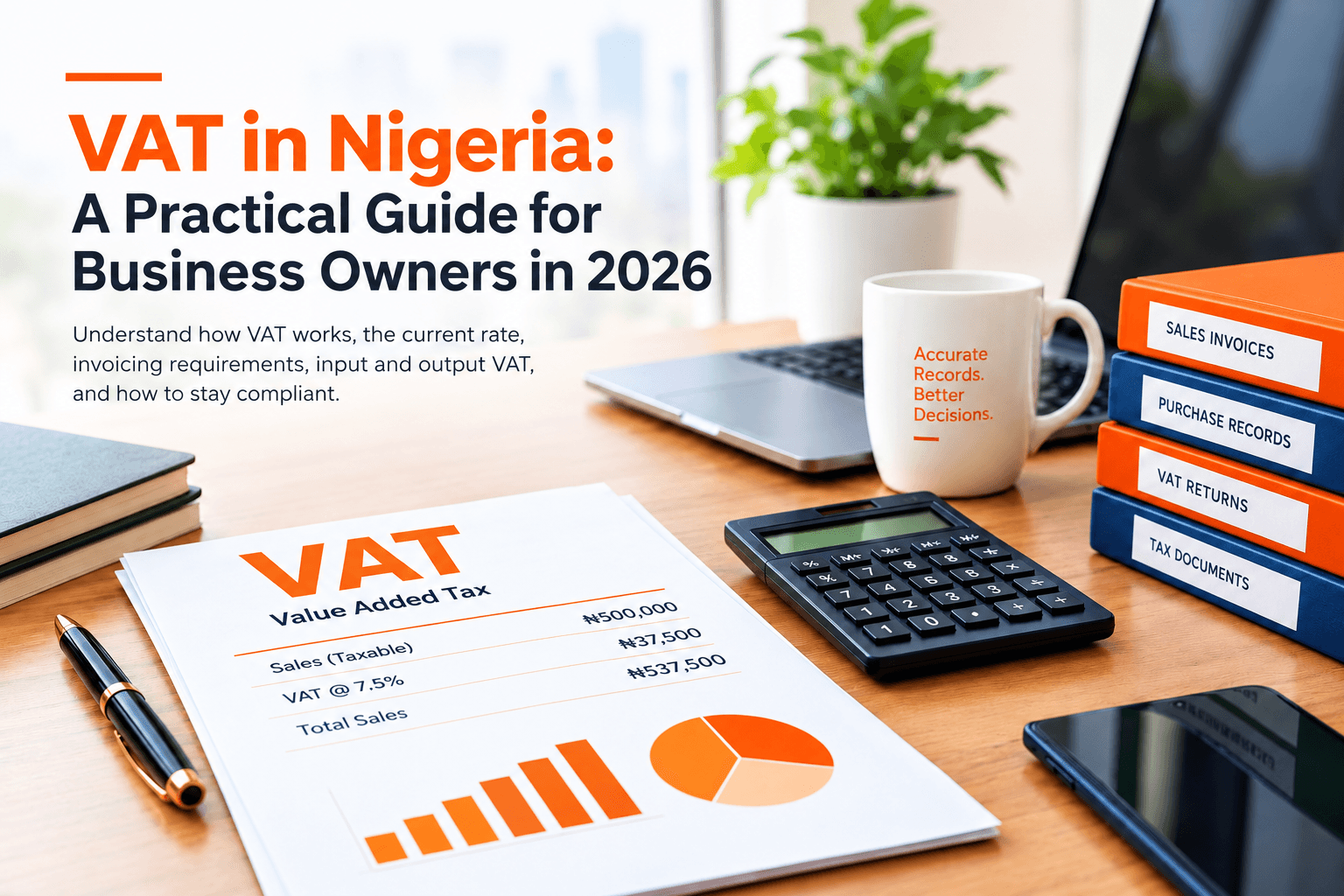
For example, if a company provides a taxable service worth ₦500,000 and the standard VAT rate applies, the VAT charged would be ₦37,500.
The business must record the transaction and account for the VAT in accordance with the applicable rules.
2. Input VAT
Input VAT is VAT paid on purchases made by a business.
Under the Nigeria Tax Act 2025, qualifying input VAT may be deductible against output VAT, subject to the statutory conditions and the extent to which the purchase relates to taxable supplies.
Eligible input VAT can include VAT incurred on certain goods, services, and fixed assets. However, not every expense automatically qualifies for a deduction.
Businesses should retain valid invoices and supporting documents and obtain professional guidance where the treatment of a purchase is unclear.
3. Understanding the Difference
Consider a simplified example:
- Output VAT collected on taxable sales: ₦150,000
- Eligible input VAT on qualifying purchases: ₦40,000
- Illustrative net VAT payable: ₦110,000
This calculation is for explanation only. The actual amount payable depends on the applicable rules, the validity of the supporting documents, and any other adjustments or restrictions.
How to Improve VAT Compliance in Your Business
Good VAT management starts with organised records and consistent procedures. The following steps can help your business maintain better control over its tax obligations.
1. Review Your VAT Registration Status
Confirm whether your business is required to register for VAT and ensure that its tax registration details are accurate.
Do not rely solely on informal advice or assumptions based on business size. Review the current legal requirements applicable to your circumstances.
2. Classify Your Products and Services Correctly
Create a clear list of the goods and services your business supplies.
Identify which transactions are taxable, zero-rated, or exempt under the relevant legislation. This helps reduce errors when preparing invoices and calculating VAT.
Where your business offers several products or services, document the VAT treatment of each category.
3. Issue Proper VAT Invoices
Maintain a consistent invoicing process for taxable supplies.
Under the Nigeria Tax Act 2025, VAT invoices are subject to prescribed information requirements. Relevant details include the supplier's tax identification information, business details, a sequential invoice number, date of supply, customer information, transaction amount, and VAT charged and rate.
Ensure that invoices are accurate, sequentially numbered, and supported by the underlying transaction records.
4. Keep Complete Purchase and Sales Records
Record all relevant sales and purchases promptly.
Your records should make it possible to identify:
- The customer or supplier involved
- The date and nature of the transaction
- The amount before VAT
- The VAT charged or paid
- The invoice or receipt reference
- The payment status
- The supporting documents
Good record-keeping makes it easier to prepare returns, investigate discrepancies, and respond to questions from tax authorities.
5. Reconcile Your VAT Records Regularly
Do not wait until a filing deadline to review your VAT figures.
Compare sales records with issued invoices, bank receipts, accounting entries, and other relevant documents. Review purchase invoices to determine whether input VAT has been recorded correctly and qualifies for deduction.
Investigate differences promptly instead of carrying unexplained balances into the next reporting period.
6. Monitor Filing and Payment Deadlines
Maintain a tax calendar showing relevant filing dates, payment deadlines, and internal review dates.
Assign responsibility for preparing, reviewing, and submitting VAT returns. Where an external accountant or tax adviser is involved, agree on when records must be provided and who is responsible for each stage.
Always verify the current filing and payment requirements with the relevant tax authority, particularly where new administrative guidance applies.
7. Use Accounting Software or a Reliable Record-Keeping System
A suitable accounting system can help your business record transactions, organise invoices, track VAT amounts, and produce reports for review.
However, software alone does not guarantee compliance. Tax codes, transaction classifications, and reporting settings must be configured correctly and reviewed regularly.
Smaller businesses that are not ready for accounting software can still begin with a structured record-keeping process, provided it captures the necessary information accurately.
8. Review VAT Treatment Before Pricing Products and Services
Businesses should understand whether advertised prices include VAT or exclude it.
If VAT applies, failing to account for it when setting prices can reduce expected margins or create disagreements with customers.
Review quotations, contracts, invoices, and online checkout settings to ensure they communicate the applicable VAT treatment clearly.
Common VAT Mistakes Businesses Should Avoid
Several recurring mistakes can make tax compliance more difficult.
Applying VAT to every transaction without checking its treatment. Some supplies may be exempt or zero-rated. Confirm the correct classification before charging VAT.
Treating all VAT paid on purchases as deductible. Input VAT deductions are subject to statutory conditions. Retain supporting documents and verify eligibility.
Failing to issue or retain proper invoices. Missing or inaccurate documentation can complicate reconciliations and make it harder to support reported figures.
Mixing personal and business transactions. Poor separation of transactions makes accounting and tax reviews more difficult.
Ignoring differences between accounting records and tax returns. Investigate discrepancies before submitting a return.
Using outdated tax guidance. Nigeria's tax framework changed in 2026. Review current legislation and administrative guidance rather than relying entirely on older articles or procedures.
Leaving compliance until the deadline. Late preparation increases the likelihood of errors, missing documents, and missed obligations.
What Documents Should a Business Keep for VAT Purposes?
A practical VAT record-keeping checklist includes:
- Sales invoices and sales summaries
- Purchase invoices and receipts
- Credit notes and debit notes, where applicable
- Bank statements and payment records
- Accounting ledgers and transaction reports
- VAT calculations and reconciliation schedules
- Copies of submitted returns and payment evidence
- Relevant contracts and supporting documents
- Correspondence with tax authorities and professional advisers
The precise records required may vary depending on the business, the transactions involved, and the applicable legal requirements.
Keep documents organised by reporting period so that they can be retrieved easily when needed.
How VAT Compliance Supports Better Financial Management
VAT compliance is not only about submitting tax returns. It also depends on the quality of a business's financial information.
When records are accurate and current, management can better understand sales, expenses, cash movements, and tax obligations.
A structured process can also help business owners identify discrepancies earlier, reduce last-minute administrative pressure, and make more informed decisions about pricing and cash flow.
Separating VAT amounts from ordinary operating funds in internal cash-flow planning can help prevent a business from mistakenly treating all customer receipts as money available for spending.
How Bodman Finance Can Help
Understanding tax rules is only one part of maintaining good financial management. Businesses also need reliable records, consistent accounting procedures, and a clear process for meeting their compliance responsibilities.
Bodman Finance provides accounting, tax, audit and assurance, and financial advisory services. Businesses seeking support can explore the company's services to identify the assistance relevant to their accounting and tax needs.
Professional support can help businesses review financial records, improve documentation, investigate discrepancies, and establish more organised compliance procedures.
Frequently Asked Questions About VAT in Nigeria
What is the VAT rate in Nigeria in 2026?
Nigeria's standard VAT rate is 7.5% as of 2026. The appropriate treatment of an individual transaction depends on whether the supply is taxable, zero-rated, or exempt under the applicable law.
Is VAT the same as company income tax?
No. VAT applies to taxable supplies of goods and services, while company income tax generally applies to taxable company profits. They are separate tax obligations.
Can a business deduct VAT paid on purchases?
Qualifying input VAT may be deducted against output VAT, subject to the requirements of the Nigeria Tax Act 2025. Businesses should verify eligibility and maintain the required supporting records.
Do all goods and services attract VAT?
No. Certain supplies may be exempt or zero-rated. Businesses should check the applicable statutory classification before charging VAT.
Why should a business reconcile VAT records regularly?
Regular reconciliation helps identify differences between sales records, purchase invoices, accounting entries, and VAT calculations before a return is submitted.
Where can businesses confirm current VAT requirements?
Businesses should consult the current Nigeria Tax Act 2025, the Nigeria Tax Administration Act 2025, and relevant guidance published by the Nigeria Revenue Service. Professional tax advice may also be appropriate where the treatment of a transaction is uncertain.
Final Thoughts
VAT compliance is easier to manage when a business understands the rules that apply to its transactions and maintains reliable financial records throughout the year.
Review your VAT obligations, classify supplies correctly, issue appropriate invoices, retain supporting documents, and reconcile records regularly. These practices can help reduce avoidable errors and improve financial control.
Because tax legislation and administrative guidance can change, businesses should verify current requirements before making compliance decisions.
Disclaimer: This article provides general educational information and is not a substitute for professional tax, accounting, or legal advice. VAT treatment depends on the facts of each transaction and the legislation and guidance applicable at the relevant time.
References
Categories: VAT Nigeria, Value Added Tax, Tax Compliance, Nigeria Tax Act 2026, Business Tax, Tax Records
0 Comments
Leave a comment
Comments are moderated before they appear. Links and email addresses aren't allowed.